AMIGOpy
Open-source software for medical images and radiotherapy, with modules for dual energy CT, brachytherapy dosimetry, Monte Carlo pre- and post-processing, 4DCT, image registration, segmentation and 3D-printed phantoms. Python, PySide6 and VTK. GNU GPL v3.
AMIGOpy is the Python successor of AMIGO, a MATLAB platform developed from 2011 that coupled images and brachytherapy plans to the MCNP6 Monte Carlo code. The software is in an alpha phase: a compiled Windows build exists, not all features are included in it, and none has been validated for clinical use.
Applications
Status reflects the source tree in November 2026. "Available" means the code is present and used, not that it has been validated. The full feature table is in the overview.
Imaging and RT-DICOM
CT, CBCT and MR series, up to 12 side by side, with RTSTRUCT, RTDOSE and brachytherapy RTPLAN overlays. NIfTI, MetaImage, TIFF and mesh input.
Dual energy CT
Calibration on phantom inserts and maps of relative electron density, Zeff, I-value and proton stopping power ratio with the Saito and Hünemohr parametrisations.
Brachytherapy
TG-43U1 dose from the RTPLAN dwell positions, DVH metrics, EQD2, uncertainty bands and simulation of catheter shift and dwell time errors.
Monte Carlo
CT calibration, material and density maps, MCNP lattice and source cards from the plan, dose-to-water and dose-to-medium mesh tallies, and meshtal import as a dose series. TOPAS is planned.
4DCT and breathing curves
Phase playback and series splitting; import, generation and editing of respiratory signals.
Registration and evaluation
Manual and SimpleITK registration (translation, rigid, affine; mutual information, mean squares, correlation). Gamma analysis and isodose templates.
Contours and segmentation
Drawing tools, thresholds and ROIs; TotalSegmentator auto-contouring in a bundled worker process.
3D printing
STL export of structures, filament and infill selection against ICRU 44 tissues from a calibration database, G-code splitting.
Interface
One window with a data tree of everything in memory, module tabs (View, Compare, DECT, Segmentation, Plan, Evaluation, Breathing curves, 3D view, 3D printing), three orthogonal views with up to four overlaid layers, and a 3D VTK view.
Data is loaded by right-clicking a folder in Windows Explorer, by drag and drop onto the data tree, or from the File menu.
Interface documentation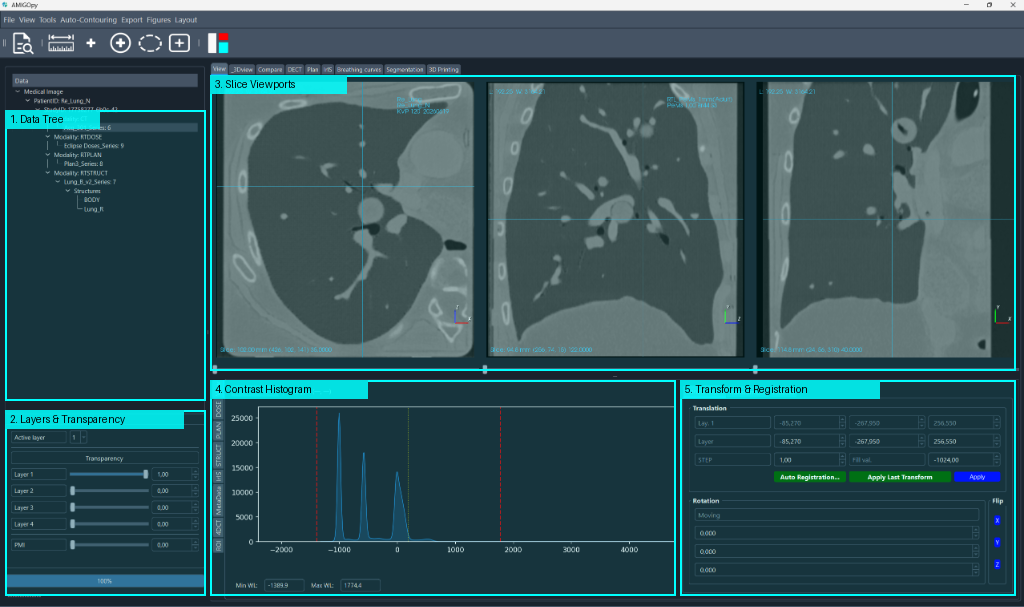
Citing
Fonseca GP, Reniers B, Landry G, et al. A medical image-based graphical platform: features, applications and relevance for brachytherapy. Brachytherapy 2014;13(6):632-639. doi:10.1016/j.brachy.2014.07.004. Other papers that describe or use AMIGO are listed under Publications.